Auto Loan Interest Deduction Rules for 2025 Through 2028
You may be able to deduct up to $10,000 of the interest on a new vehicle loan taken after December 31, 2024. Whether you qualify comes down to your vehicle, your income, and how your loan is written.
This page walks through all three, then explains the form your lender sends. It covers federal rules only, and it isn't tax advice. Your own return depends on details a web page can't see, so run the final decision past a tax professional.
The Three Things That Decide Whether You Qualify
All three have to be true in the same tax year. Miss one and the interest stops counting.
Your vehicle
Its original use has to begin with you, and final assembly has to happen in the United States. Cars, minivans, vans, SUVs, pickup trucks, and motorcycles qualify when the gross vehicle weight rating stays under 14,000 pounds. Used vehicles and leases don't qualify.
Your income
The full $10,000 is available while your modified adjusted gross income stays at or below $100,000. That threshold doubles to $200,000 if you file jointly. Above the line the amount shrinks on a sliding scale, and the next section shows the math.
Your loan
The loan has to be secured by a first lien on the vehicle itself. You also have to have taken it out after December 31, 2024. Refinancing doesn't automatically break this. If the new loan still holds a first lien on the same vehicle, it still counts.
One requirement catches people out at filing time. You have to put the vehicle identification number on your tax return for every year you claim the deduction. Keep it somewhere you'll find it in April.
The deduction is claimed on Schedule 1-A, Additional Deductions, which the IRS published on March 2, 2026. Part IV of that schedule is the section covering car loan interest, and it has a box for your VIN.
How Much of Your Interest Actually Counts
The ceiling is $10,000 of interest per year. It's open to people who itemize and to people who take the standard deduction. According to the IRS guidance on the 2025 tax deductions, that ceiling holds for tax years 2025 through 2028.
Above the income threshold, the $10,000 drops by $200 for every $1,000 of income over the line. Part of a thousand counts as a whole step, which is how the form itself works it out. The table below runs the numbers for a single filer.
| Your MAGI | Amount over $100,000 | Reduction | Most you can deduct |
|---|---|---|---|
| $90,000 | None | $0 | $10,000 |
| $110,000 | $10,000 | $2,000 | $8,000 |
| $130,000 | $30,000 | $6,000 | $4,000 |
| $150,000 or more | $50,000 | $10,000 | $0 |
So a single filer stops qualifying at $150,000. For joint filers every figure in that table shifts up by $100,000, which puts the cut-off at $250,000.
Two things are worth remembering. The cap limits the interest you can count rather than the money that comes back to you. You can also only deduct interest you genuinely paid, so if you paid $3,200 last year, $3,200 is your number. Our guide to how the phase-out works runs through more filer situations.
One more thing catches people who use the car for work. Interest you already claim as a business expense can't be counted again here, and the schedule asks you to separate the two. Our guide to personal and business use explains how to separate the interest.
Checking Whether Your Vehicle Makes the Cut
Final assembly in the United States is the requirement that trips up the most buyers. A familiar American badge doesn't guarantee an American assembly plant, and plenty of imported brands build in US plants.
You can't settle it by reading one character of the VIN, whatever you may have seen elsewhere. The leading characters name the manufacturer, and where the car was actually assembled sits further along the number.
Run the whole VIN through the NHTSA VIN decoder, which reports the plant and the country it sits in.
Your VIN sits on your registration, your insurance card, and the plate at the base of the windshield. Our VIN eligibility check walks through it step by step, and the IRS has published its rules on which vehicle loans qualify.
Two other limits sit alongside assembly. The vehicle has to be new when you take delivery, which rules out used and certified pre-owned cars. It also has to be financed rather than leased.
If you're weighing that second point, we've written separately on leased and financed vehicles.
What Form 1098-VLI Is and When You Should Expect It
Form 1098-VLI is the statement your lender uses to report the interest you paid them. It carries the interest total, the year, make, and model, your VIN, the loan origination date, and the outstanding principal. The form gives you the loan interest, vehicle, and lender details you'll use with Schedule 1-A.
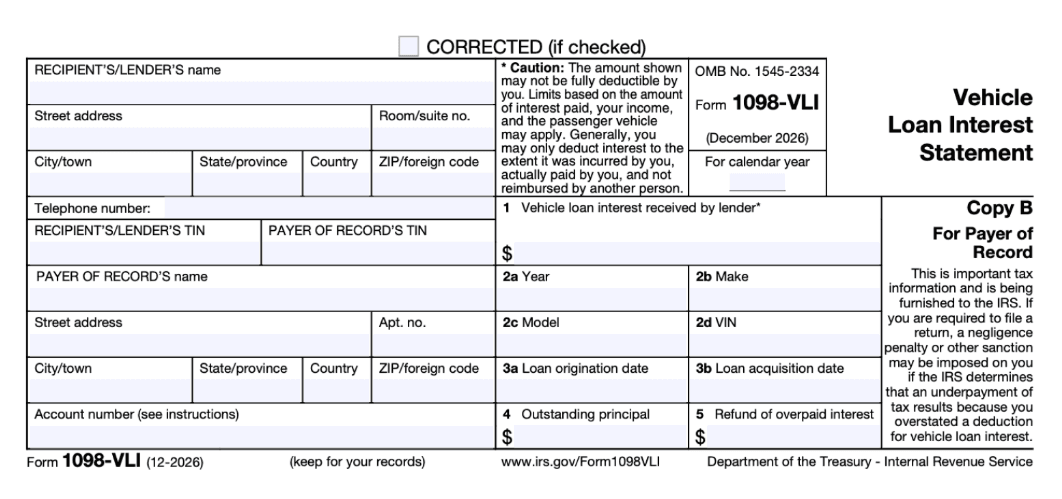
The reporting duty starts at $600. A lender that took $600 or more in interest from you on a single loan has to report it and send you a statement. Below $600 on that loan they don't have to send anything, though you may still be able to claim the interest.
2025 works differently. The IRS granted relief for the 2025 calendar year, so a lender didn't have to issue the form for 2025 at all. Making your interest total available by January 31, 2026 was enough, through an online portal, a monthly statement, or an annual summary. See the IRS transition relief for 2025.
If no 1098-VLI turned up for 2025, that's likely why. Check your lender's portal first. From the 2026 tax year onward the form itself applies.
Our walkthrough covers each box on the form, and a fuller explainer covers what Form 1098-VLI reports.
Common Questions About the Auto Loan Interest Deduction
Can I claim this deduction without itemizing?
Yes. The IRS says the deduction is open to taxpayers who itemize and to those who take the standard deduction. It's claimed on Schedule 1-A rather than Schedule A, so taking the standard deduction doesn't rule you out.
What if my lender doesn't send me Form 1098-VLI?
For the 2025 tax year, they may not owe you one. The relief described above let lenders publish the interest total through a portal or statement instead. From 2026 onward the form itself is expected. Any lender that received $600 or more in interest on your loan has to report it and send you a statement. Our guide on what to do if your lender hasn't sent it covers how to chase the number down.
Does my electric vehicle qualify?
Nothing in the rules excludes electric vehicles as a category. An EV faces exactly the same three tests as any other vehicle. US final assembly, new original use, a first-lien purchase loan, and a weight rating under 14,000 pounds all still apply. We've covered the specifics of electric vehicle eligibility separately.
What if I refinanced my auto loan in 2025?
Refinancing on its own doesn't end the deduction. What matters is whether the replacement loan is still secured by a first lien on the same vehicle. When it is, the new loan is treated the same way as the original. The picture gets more complicated once you roll other balances in, so our notes on refinanced auto loans are worth a read.
Is the deduction available in every state?
It's a federal deduction, so it applies on your federal return wherever you live. Your state return is a separate question. States differ in how closely they follow federal rules, and we've written about state tax treatment in more detail.
What Lenders Have to File Under Section 6050AA
If your institution receives $600 or more in interest on a qualifying vehicle loan, Section 6050AA requires you to report it to the IRS. You also have to provide the borrower a statement. The threshold applies per loan, measured against each loan on its own.
For the 2025 calendar year the IRS allowed a simpler route, and no form was required. From 2026 onward Form 1098-VLI applies, and the usual information return deadlines come with it.
We file Form 1098-VLI on your behalf. You upload your borrower data, review the generated forms, and we submit them to the IRS.
| Service | Price | What you get |
|---|---|---|
| eFile Only | $3.00 per form | Borrower data upload, Form 1098-VLI generation, and IRS eFiling. |
| eFile + Print/Mail | $4.50 per form | Everything above, plus printed borrower copies mailed for you. |
A $750 annual minimum applies to both.